Counseling Learning Resources
Keep Learning.
At Your Own Pace.
Explore the ideas behind assessment and mental health care—with visual guides, practical examples, and a professor who happens to be a brain.
Choose a Learning PageFree to explore. No account needed. Come back anytime.
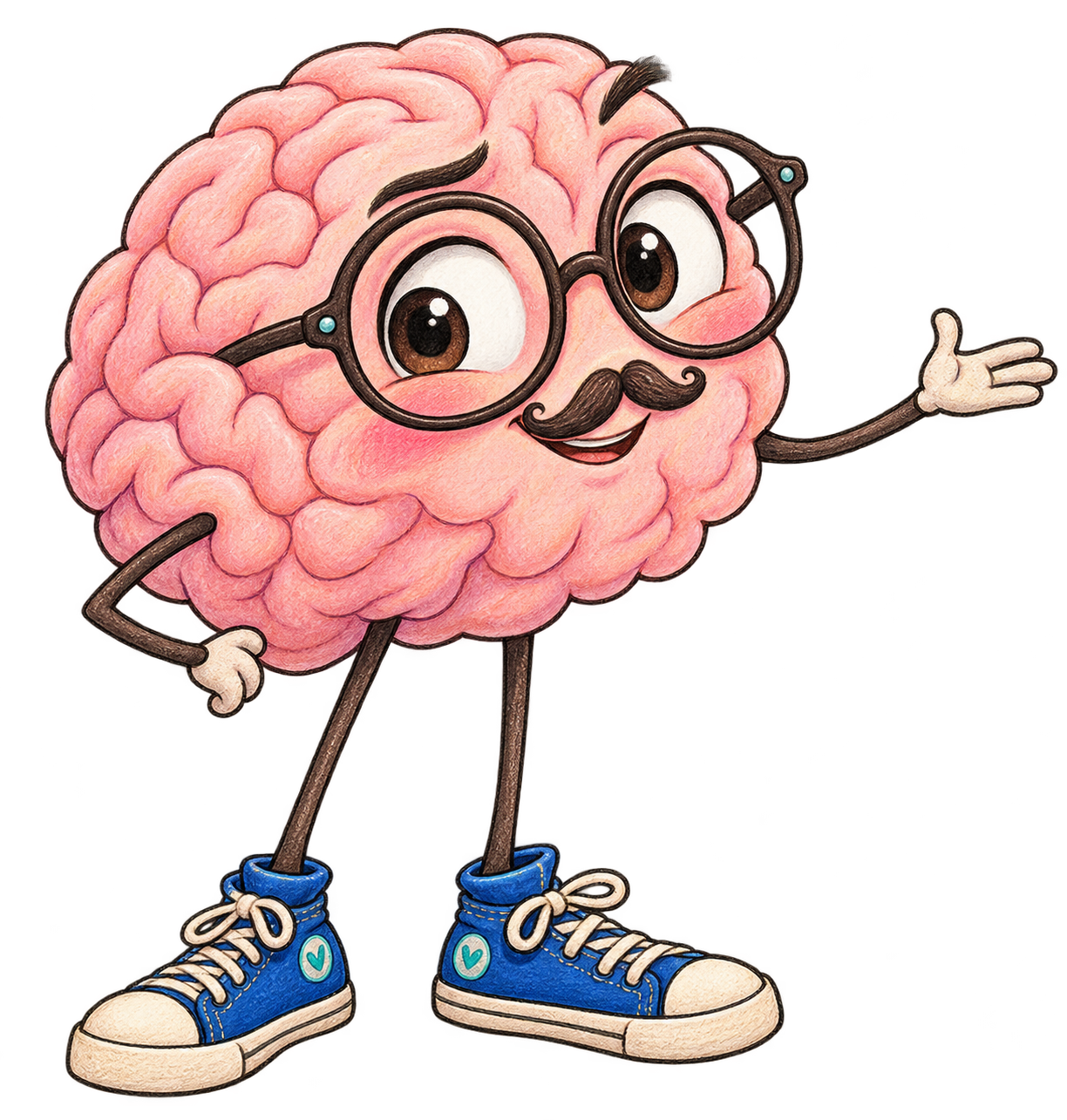
and I'm here to help!
Start Here
Choose What You Want to Explore
Open a page, choose a topic on the brain map, and follow your curiosity.

Counseling Assessment
Build your understanding of assessment, measurement, interpretation, and thoughtful clinical decisions.
Explore AssessmentChild & Adolescent
Psychopathology & Treatment
Explore mental health across development, with attention to young people, their families, and treatment.
Explore Child & Adolescent TopicsAdult & Geriatric
Psychopathology & Treatment
Connect symptoms, life context, differential diagnosis, and treatment across adulthood and later life.
Explore Adult & Geriatric TopicsThese pages stay available after your class ends. Bookmark the topics you find useful and return whenever you want to review.
More Than a Page of Notes
Find Your Topic
Move through the interactive brain map, or use the topic list for a straightforward reading path.
Make the Connections
Read explanations, explore figures and study guides, and work through fictional clinical examples.
Try It Out
Use optional knowledge checks and learning games to practice. The activities do not count toward a course grade.
Meet the Educator
Levi Armstrong, PsyD, MSCP

Dr. Levi Armstrong is a clinical and forensic neuropsychologist, a full-time graduate professor in clinical mental health counseling, and the owner of Integra Psychological Services in Wylie, Texas. He also holds an advanced postdoctoral master’s degree in clinical psychopharmacology. His work brings together brain–behavior relationships, psychological assessment, mental health treatment, and the education of future counselors.
He created BrainDadLabs to make complex clinical ideas easier to understand, more enjoyable to explore, and available long after a class ends. His passion for this project comes from the connection between understanding how people learn and helping students become thoughtful clinicians who can explain, question, and apply what they know.
Built Around How We Learn
The design draws on cognitive psychology and the neuroscience of learning and memory. Focused readings, purposeful visuals, fictional clinical cases, and low-stakes practice give you several ways to work with an idea. The brain map and Doctor BrainDad make exploration playful; the learning happens as you connect concepts, recall them, and put them to use.
- Recall, Then Check.
- Try the questions and learning games, then use feedback to examine your reasoning.
- Return Over Time.
- Revisit a topic on different days and try explaining it before rereading. Spaced review gives you another opportunity to retrieve what you learned.
- Connect the Ideas.
- Pair explanations with relevant figures and work through cases to consider how the concepts fit together.
The Learning Research Behind the Design
- Retrieval Practice and the Brain — Wing, Marsh, & Cabeza (2013)
An fMRI study of the testing effect and later memory. - Learning From Feedback — Butler & Roediger (2008)
Corrective feedback following multiple-choice practice. - Spacing Learning Over Time — Cepeda and Colleagues (2008)
The relationship between review intervals and later retention. - Connecting Words and Pictures — Mayer & Anderson (1992)
Learning with coordinated visual and verbal explanations.
BrainDadLabs is an independent educational project. These resources are designed to support understanding, thoughtful practice, and continued learning.